Friday, March 4, 2016

STREET ART IN MEXICO AND LATIN AMERICA


There is something very special about walking down a random street and seeing colorfully painted street art, or murals, by artists who are truly gifted. Street art often reflects social, cultural, and political views and because it is inexpensive to create and to view it is accessible to people of all backgrounds, interests, and persuasions.


San Miguel de Allende, Mexico

Because street art is primarily created in public locations it may be unsanctioned more often than not. It is artwork executed outside the context of traditional art venues. And like much art, there is much room for interpretation. Street art, like most art, really comes down to the eyes of the beholder. To me that is what makes street art just as interesting and exciting as art found in more typical settings.The line between street art and graffiti can be blurred for many. In some cases street art can be a thriving community project, but some people only see it as a source of vandalism with ugly tagging.


Valparaiso, Chile

The term “street art” gained popularity during the graffiti art boom of the early 1980's and continues to be applied to subsequent incarnations. The terms "urban art”, "guerrilla art”, “post-graffiti," and "neo-graffiti" are also sometimes used when referring to street art. Street art is often motivated by the artist to communicate directly with the public at large and free from perceived confines of the formal art world. Street artists sometimes present socially relevant content with an aesthetic appeal in order to attract attention to a cause.


San Miguel de Allende, Mexico


In Latin America there is no shortage of talented artists and street art can be found throughout most countries. Street artists often travel between countries to spread their designs. Some artists have gained cult-followings, media and art world attention, and have gone on to work commercially in the styles which made their work known on the streets.


Colonia Guadalupe, SAn Miguel de Allende, Mexico

“The origins of modern street painting can be traced to Britain. Pavement artists were found all over the United Kingdom and by 1890 it was estimated that more than 500 artists were making a full-time living from pavement art in London alone.


The British term for pavement artist is "screever". The term is derived from the writing style, often Copperplate, that typically accompanied the works of pavement artists since the 1700s. The term screever is most commonly cited as Shakespearean slangdating from around 1500.


The works of screevers often were accompanied by poems and proverbs, lessons on morality, and political commentary on the day’s events. They were described as "producing a topical, pictorial newspaper of current event." They appealed to both the working people, who (on the whole) could not read or write, but understood the visual images; and to the educated members of the middle-classes who appreciated the moral lessons and comments. It was important for a screever to catch the eye of the ‘well to do’ and in turn attract the pennies donated for their efforts.”


Buenos Aires, Argentina


Oaxaca, Oaxaca


Valparaiso, Chile


Buenos Aires, Argentina

STREET ART IN SAN MIGUEL DE ALLENDE, MEXICO:


Colonia San Antonio, San Miguel de Allende, Mexico


My husband and I were fortunate enough to be living in San Miguel de Allende, México when the inauguration of the first Street Art Festival took place in the Colonia (or neighborhood) of Guadalupe. San Miguel de Allende is a UNESCO world heritage city and has become quite well known, but it had never experienced anything like this art festival. It was something new, different, and very edgy.


Colonia Guadalupe, San Miguel de Allende


More street art in Colonia Guadalupe, San Miguel de Allende


The First Art Distyrict, Colonia Guadalupe, San Miguel de Allende


Tools of the street art trade


In the Spring of 2013 the city of San Miguel initiated a program with the Muros en Blanco (Blank Walls) organization naming Colonia Guadalupe as the First Art District of the city. This program provided a new option for living art in the city. By invitation a total of 33 international street artists had the opportunity to come to San Miguel and participate in the creation of new street art for the neighborhood.


Artists from different parts of the México including Tlaxcala, Oaxaca, Querétaro, León, Mexico City, San Miguel de Allende, and San Luis de la Paz were joined by artists from Chile, Quebec, Buenos Aires, Dresden, Houston, and New York in this project. They had the opportunity to paint a total of 15 walls under the consent and support of the owners, the neighbors, and the local administration. Their works reflect a mix of styles, techniques, and trends which are now a permanent collection in the streets of Colonia Guadalupe. A wonderful project! I hope you enjoy their special street art with me.


STREET ART IN PUERTO VALLARTA, MEXICO


Street art in the city of Puerto Vallarta is alive and thriving. I rarely leave home without taking a camera with me in order to capture images of the wonderful and creative street art that can be found. The following are a sample of my favorite street art creations with more for your viewing in the accompanying album that you find at the end of this posting. In the near future I plan on exploring more areas of this wonderful town in order to find more street art to share. Until then, enjoy!


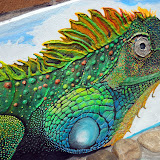
This handsome iguana is found near the Isla on the Rio Cuale in Old Town.


More near the Rio Cuale in Old Town, Puerto Vallarta


He is definitely one of my favorite iguanas in Puerto Vallarta!

This collection of street art images features many motifs of the Huichol indigenous culture as seen in Old Town, Puerto Vallarta.


A full lenth photograph of my favorite Iguana near the Rio Cuale bridge inn Old town.


Found near the Municipal mercado and the phones are for real!


Stunning mural of Frida Kahlo as seen at Los Muerto Beach in Puerto Vallarta.

MADONNARI STREET ART AND HISTORY

Street painters (also called chalk artists) is the name performance artists are most commonly called in the United States, but they are known as I Madonnari in Italy (singular form: madonnaro or madonnara) because they originally created images of the Madonna.


The Italian Madonnari artist and movement have been traced to the sixteenth century. Many were itinerant artists who were brought to the large cities to work on the huge cathedrals. When the work was completed they needed to find another way to make a living and thus they would often recreate the paintings from the church onto the pavement. The term Madonnari comes from the fact that these images originally were mostly Madonnas.


A modern day "Madonna" in Puerto Vallarta.

Aware of festivals and holy days held in each province and town, these wandering artists would travel to join in the festivities with the hope of making a living from observers who would throw coins if they approved of the artist's work. For centuries, many Madonnari were folk artists, reproducing simple images with crude materials such as tiles, coal, and chalk. Others, such as El Greco, would go on to become household names.


Fabulous three-D chalk art imagery at the Mondannari Festival in Puerto Vallarta

In 1973 street painting was being promoted in Italy by the formation of a two-day festival in Grazie di Curtatone in the Province of Mantua. Festivals of this type of artistic expression eventually became known as “Madonnari Festivals.” These festivals which specialize in the chalk-art-style of painting have become internationally known and appreciated. We are certainly fortunate that this wonderful tradition continues to this very day. And I, for one, am especially happy that the City of Puerto Vallarta, México has become part of this artistic tradition.


 MADONNARI FESTIVAL IMAGES FROM PUERTO VALLARTA


Friday Kahlo and per pet monkety, Fulang Chang

The tenth Festival I Madonnari in Puerto Vallarta took place last November, 2015 on the main plaza. Last year was our first experience viewing the creative street art found at this annual event. What a wonderful surprise! The Madonnari Festival Puerto Vallarta transforms Puerto Vallarta’s main plaza into an over-sized street easel using chalk pastels on the pavement to create vibrant, colorful, and large scale images.


The annual Madonnari festival in Puerto Vallarta is organized in partnership with the Vallarta Institute of Culture, The Tourism Board, and Santa Barbara, California, the sister city of Puerto Vallarta. Santa Barbara also hosts an annual I Madonnari festival which began there in 1987. Santa Barbara was also one of the first North American cities to participate in this international event.


Handsome wolves on the Puerto Vallarta Plaza


Tigers are also seen at the Chalk Art Festival in Puerto Vallarta


Are eyes the windows to the soul?


Working under the tropical sun is not easy for these Madonnair artists!


More creative chalk art as seen in Puerto Vallarta

Plaza de Armas in Puerto Vallarta is filled with modern day artists creating special and unique works of art using chalk and pastels for three days towards the end of each November. The modern day sidewalk art are more contemporary in theme than the religious paintings of the sixteenth century, but still very enjoyable. I hope you enjoy your visit to the Festival I Madonnari in Puerto Vallarta.


May the force be with you!

I remember hearing many years ago that a picture is worth a thousand words. Those words definitely contributed to and inspired me in the creation of MEXICO AND BEYOND: LAURA'S PHOTO JOURNEY.


Below you will find my WEB ALBUM which has additional photos for this posting.


STREET ART IN LATIN AMERICA


And finallly, please scroll down to the bottom of this page in order to access the posting ARCHIVE and the FOLLOW BY EMAIL links to receive automatic posting notifications. I sincerely appreciate hearing from my readers with their questions, comments, and suggestions. Until then, gracias and safe travels! Laura


Memories are just a click away!

Thursday, January 21, 2016

MINERAL DE POZOS, MEXICO: AN EXCURSION BACK IN TIME


On the outskirts of town are sprawling old mines to explore. One of them, Mina Santa Brigida, has a trio of 50-foot-high smelting ovens dating back to the late 1500’s!

             WELCOME TO MINERAL DE POZOS! 


Mineral de Pozos (which translates to "Mineral Wells" and which is commonly referred to as "Pozos") is located in the state of Guanajuato, Mexico.  Although less than an hour's drive from either the large colonial city of Queretaro or the smaller charming town of San Miguel de Allende, it is a world away in appearance, atmosphere, and history. A visitor approaches "Pozos" through a dry chaparral desert landscape surrounded by the Sierra Gorda Mountains. With an altitude of 7,500 feet and vistas which run to the hundreds of miles it is truly awe-inspiring. There is a sense of magic about this formerly great mining area which was all but abandoned with the closing of its mines.


Some of the descriptions of Mineral de Pozos I have seen include the following which I find very telling and captivating about this unique town:  

"More than a ghost town in Guanajuato....." 

"Magical abandoned mining town in the high chaparral deserts of  Mexico.... an art and artisans community of tranquility and uncommon  beauty" 

"Mineral Wells ... a journey through time......

 "A ghost town comes alive as an artist colony"

Let's start our excursion with the following introduction to the history of Pozos.  I am a firmer believer that a little history will help us understand and appreciate the past glory of Pozos and its current charm.

Before the arrival of the Spaniards this region in Mexico was populated by nomadic indigenous tribes such as the Pames, Jonas, and others which were collectively known as the Chichimeca. In modern times only one ethnic group is customarily referred to as Chichimecs;  namely the Chichimeca Jonaz of whom a few thousand live in the state of Guanajuato.


The Chichimeca Jonaz are a group of indigenous people living in the nearby municipality of San Luis de la Paz in the state of Guanajuato.

In the middle of the Sixteenth Century after the discovery of silver in the state of Zacatecas, a leg of the Camino Real (the royal road)  passed through the valley below and to the north through the present day city of San Luis de la Paz. To protect the wagon trains moving north and south, the army established an outpost called Palmar de Vega, the first settlement of Pozos.


Old colonial ruins are a big part of the charm of Pozos as is the local way of life.


 Crumbling adobe walls and desert cactus are iconic images of Mineral de Pozos.


If only these remains could tell their story! 

Pozos was consequently born in 1576 as a mining town. It grew haphazardly alongside half a dozen other boom towns in the high, rugged central region that Mexicans call the Bajío. Around the same time, Jesuits arrived in the area to evangelize the local population. Legend has it that the indigenous people brought the priests silver that they mined in an area known today as Santa Brígida. The Jesuits then began to mine the area using European techniques which continued until approximately 1767 when they were expelled. 


The Catholic tradition is very much alive as evident by this lovely altar in Pozos. 


 Wandering through a cemetery I find fascinating and the in Pozos dates back hundreds of years.

With discoveries of silver and other mineral lodes just to the west of town, Pozos began to grow in importance as a mining district.   Within a few years Pozos began a boom period. By the last years of the 19th century the number of working mines had reached 300 and the population in Pozos had reached close to 70,000.


I find ruins intriguing and romantic regardless of their location or their culture. 


Art imitating the local scenery by local artist Sandra Mooring at her Pozos home studio.


The President of Mexico during this time, Presidente Porfiro Diaz, was one of the town's most important promoters. He elevated the town to the status of municipality and renamed it Cuidad Porfirio Diaz in his own honor (no big surprise there). Pozos achieved its height of prosperity during his presidency.  In the collapse of The Diaz government the second period of decline began in Pozos from which it would never recover. 


The quiet main plaza, Jardin Juarez, in San Mineral Pozos is a great place to relax and have an ice cream cone with a homemade flavor such as nuez de pino (pine nut)!


What a contrast!  A colonial bell and a modern microwave tower in the background! 

The metals mined in Pozos during it's boom years included gold, silver, mercury, copper and several others. Immigrants from France, Spain, Italy, England, and the United States and workers from the Mexican states of Guanajuato, Zacatecas, Mexico State, and Hidalgo all came to Pozos to seek their fortunes. The Mexican stock exchange, called the Bolsa de Valor, was founded to promote shares in Pozos mines.


It's obvious to me that this tree came before the old stone wall!


A cactus landscape and a cactus garden are both native to Mineral de Pozos.

The beginning of the Mexican Revolution in 1910, however, marked the beginning of the end for Pozos. The closing of mining operations during the fighting and the subsequent flooding of the mines combined with a dramatic fall in the world price of silver caused the mines to begin closing. The mines were gradually abandoned with the last mine closing in 1927.

Tumbleweeds began rolling in, residents left, and Pozos turned into a virtual ghost town.  By the 1950's there were perhaps only 200, or less, people living in Pozos. Not until 1982 was the significance of Pozos officially recognized when the Mexican government under President Jose Lopez-Portillo decreed Pozos a National Historical Treasure.


Mina of Five Lords
I think the stone arches of the colonial ruins make these buildings look as if they could fly away.


 According to a recent census, the population of Pozos has grown to approximately 2,500 which includes 
farmers, herders, and people who commute to nearby towns and factories. It is also once again being inhabited by people from many parts of Mexico as well as a small, but energetic group of foreign expatriates, who are rescuing the old houses, plazas, and streets of Pozos. The surrounding area has centuries-old mines and nearby haciendas which evoke the riches of now-exhausted silver and gold deposits.  Que romantico!  


Jardin Juarez (named in honor of one of the most popular presidents to rule Mexico, Benito Pablo Juárez García) is the main plaza in Mineral de Pozos.


 Mineral de Pozos with its cobbled and hilly streets can be a real workout!


     San Pedro (Saint Peter) Parish Church in Mineral de Pozos.

Whether your passion is art, archaeology, painting, photography, sculpting, writing, hiking, biking, reading, or relaxing, Pozos offers a full range of options. Daytime can be filled with any number of interesting excursions into the surrounding countryside. Exploring ancient ruins, old haciendas, and churches are popular pastimes in Pozos. Visits to resident artists and sculptors provide an interesting glimpse into the creative talent that resides here.


POSADA DE LOS MINAS


  Out of the colonial remains of Pozos flowers bloom and a renaissance is taking place in this charming town.


  I am very fond of the aesthetics of rustic furniture although its comfort factor is definitely a challenge.

Scattered around town in Pozos are a number of art galleries, studios, and handicrafts stores to entice a visitor.  A number of these stores specialize in replicas of Pre-Hispanic musical instruments and jewelry made from semi-precious stones.  It is noteworthy that many of its present inhabitants are dedicated to the manufacture of pre-Hispanic instruments.


BEVERLY SKY, a fiber (fabric) artist and paper-maker from Boston, spends part of the year in Pozos. She is quoted as saying:  "for the price of a parking space on Beacon Hill," she bought an artist's home with 150-year-old walls and a triangular courtyard.  "This is classic Pozos," she said. "A little bit cold and chilly and then the sun." I simply adore the contrast of her art with the original rustic walls at her gallery.


Vibrant fabric art by Beverly Sky as seen at her wonderful GALERIA CASA DEL CIELO


A local hand crafts tienda in Pozos with all sorts of interesting offerings!

                                          crafts
Pozos is known for its artisans who produce and play musical instruments based on ancient pre-Hispanic designs. Each piece is handmade by the very artisans who you will often find personally selling their creations around the Plaza Zaragosa.


venado azul pozos 3
Handmade traditional instruments, including drums, can be found at LA CASA DEL VENADO AZUL as can accommodations.


At the iron sculpture foundry and gallery of Arturo Cabrera architectural items are crafted in addition to whimsical iron creations. Also on display were ALEBRIJE style fantasy creatures similar to those found in Oaxaca.

                           Fabulous ALEBRIJE pieces are entirely handmade and hand painted - wow!


  The lovely courtyard of EL SECRETO B&B


Sculpture of an indigenous woman in garden of artist Sandra Mooring on the outskirts of Pozos.


Another studio and gallery belongs to DANIEL RUEFFERT, an artist who after spending three decades in nearby San Miguel de Allende, bought a home in Mineral de Pozos and invested in a restaurant.


   I am a great fan of the work of Daniel Rueffert now residing and creating in Pozos.              


I love cactus and this cactus garden at Galeria 6 and El Secreto B&B make me happy!  

After your fill of art and galleries it is possible to enjoy a rich selection of annual cultural events offered in Pozos. Each year during the month of July the feast of the Toltequity where musicians from different regions of Mexico gather in a Pre-Hispanic music festival. The festival celebrates Toltequity ethnic richness and diversity by promoting cultural and artistic exchanges between the peoples of the Chichimeca nation. The festival includes exhibitions, craft workshops, music, and other entertainment.  See list of other events held in Pozos near the end of this blog.


Mineral de Pozos, once known throughout colonial Mexico for its opulence and its thriving mining industry, has been a virtual ghost town for almost a century. It is experiencing a resurgence of interest on the part of visitors looking for an unique adventure.

On February 16, 2012 Mineral de Pozos was declared a  PUEBLO MAGICO in Mexico as part of the federal program that recognizes places and people with great cultural, culinary and artistic value.  Bravo!  

See the following for images of the celebration:  PUEBLO MAGICO: MINERAL DE POZOS


I hope you have enjoyed this excursion "back in time" and "now in time" at the charming town of Mineral de Pozos!  And if you need more of an excuse or reason to visit Pozos here is a schedule of events for the calendar year 2015 which will give you an idea of what may be expected in 2016. Please be sure to verify events and exact dates. Remember: In Mexico events and schedules can change without much notice so it's always a good idea to check ahead!     


January: Mines and Music Festival
February: Art Walk
March: Home and Garden Tour
April: Easter and Passion Play
May: Mariachi Festival
City’s Anniversary Porfirio Diaz Day
Mineral de Pozos’s Sound
Lord of the Works Festival
July: Toltequity Festival
Blues Festival
Art Walk
August: Mines and Music Festival
Home and Garden Tour
November: Day of the Dead
December: Christmas Fair


 I remember hearing many years ago that a picture is worth a thousand words. Those words definitely contributed to and inspired me in the creation of MEXICO AND BEYOND: LAURA'S PHOTO JOURNEY. Below you will find my WEB ALBUM WITH ITS SLIDE SHOW which has additional photos for this posting.

I sincerely appreciate hearing from my readers with their questions, comments, and suggestions. Until then, gracias and safe travels! Laura


                                                   Memories are just a click away!


CLICK ON PHOTO FOR SLIDE SHOW 


DISCLAIMER: Images taken from the Internet are assumed to be in the public domain. In the event that there is a problem or error with copyrighted material, the break of the copyright is unintentional and the material will be removed immediately upon request.